
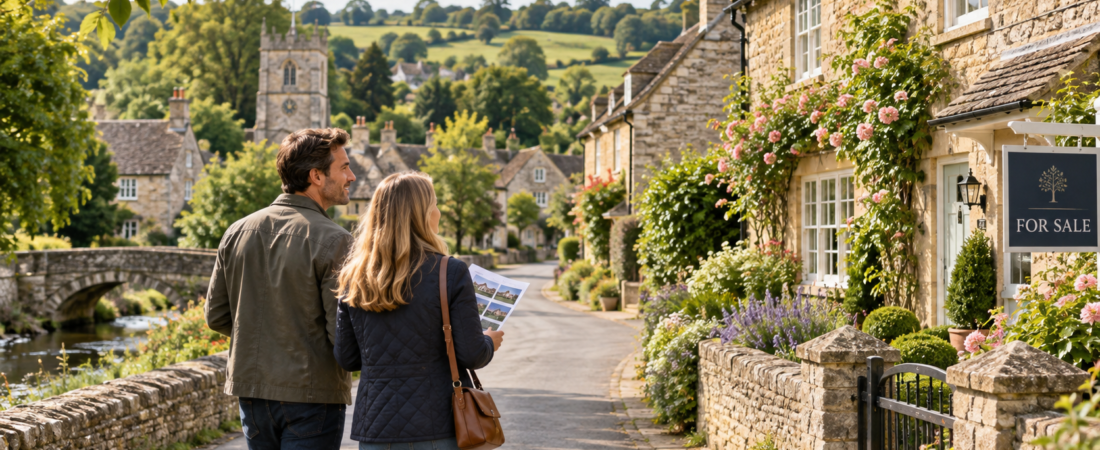
Moving to a village can sound idyllic.
Quiet lanes. Country walks from your front door. A proper local pub. More space. Less traffic. Maybe even a house with beams, a fireplace and a garden that would have been completely unaffordable in London.
And, for the most part, village life can be every bit as lovely as it looks.
But there are also plenty of things that are easy to overlook when you’re standing outside a beautiful cottage on a sunny Saturday afternoon.
When we were looking at moving from London to the countryside, I quickly realised that buying a house in a village involves a slightly different checklist.
Things I had barely thought about before — mobile signal, taxis, oil tanks, rights of way and the last train home — suddenly became surprisingly important.
So if you’re thinking of making the move, here are 25 things I’d check before buying a house in a village.
1. Check the broadband speed at the actual house
Don’t assume that because the village has broadband, the house you’re buying will have good broadband.
Rural broadband can vary enormously from one road to another — and sometimes even between neighbouring properties.
If you work from home, stream television or regularly make video calls, check the specific address, not just the general area.
Ofcom has a broadband checker that allows you to search individual UK addresses and see what broadband services and predicted speeds are available.
I’d also ask the sellers what speeds they actually get.
2. Check your mobile signal
This is another one that can easily be forgotten during a viewing.
Your phone may work perfectly outside the house but have almost no signal once you step inside.
Old cottages with thick walls can make this even worse.
Check your own phone while you’re there, but also look at coverage for other networks in case switching provider would solve the problem.
Ofcom’s checker shows predicted indoor and outdoor mobile coverage by network.
3. Work out how far you really are from the station
Estate-agent descriptions can be wonderfully optimistic.
“Convenient for the station” might mean a seven-minute drive.
Or it might mean 25 minutes down single-track country lanes.
Put the journey into Google Maps during the time you’d actually commute, rather than relying on the distance.
And remember to include parking and the walk from the car park to the platform.
4. Check the last train home
This sounds trivial until you live somewhere where missing one train changes your entire evening.
If you’re moving out of London but still expect to go into the city for dinners, theatre, work events or drinks, look up:
- the last train
- the last fast train
- how frequently trains run in the evening
- Sunday services
- what happens during engineering works
A 35-minute commute sounds fantastic until you discover trains only run once an hour late at night.
5. Find out whether you can actually get a taxi
This was something I never really thought about in London.
In smaller villages, Uber may not exist — or you might open the app and find absolutely nobody available.
Local taxi firms may need to be booked in advance.
Try searching for local companies and, ideally, call one before you move to see how easy it would actually be to get a taxi home from the station at 11pm.
6. Check whether there is a village shop
A village shop can make a surprisingly big difference.
Running out of milk in London is mildly annoying.
Running out of milk when the nearest supermarket is a 20-minute drive away feels rather more significant.
Find out where you’d actually go for everyday essentials.
7. Check supermarket delivery coverage
Being rural doesn’t necessarily mean giving up online grocery shopping — but don’t assume every supermarket delivers to every village.
Try entering the prospective postcode into the websites of the supermarkets you normally use.
I’d check:
- Waitrose
- Ocado
- Tesco
- Sainsbury’s
- Morrisons
It sounds minor, but weekly grocery delivery becomes extremely useful when shops aren’t around the corner.
8. Look at the pubs
This may sound like an excuse to research pubs.
It is.
But the local pub can genuinely become a much bigger part of life in a village.
It’s somewhere to eat, meet neighbours, take visiting friends and wander to on a Friday evening.
Check whether your village actually has one — and whether it’s somewhere you’d want to go.
I’d also look at whether it appears busy and well supported locally. Rural pubs unfortunately aren’t guaranteed to stay open forever.
9. Check the nearest GP, dentist and pharmacy
You probably won’t need them every week.
But when you do need them, you don’t want to suddenly discover they’re half an hour away.
Look up:
- GP surgeries
- pharmacies
- dentists
- urgent treatment centres
- nearest hospital
It’s especially worth considering if you’re moving with young children or older family members.
10. Check the roads at rush hour
A pretty country lane at 11am can be a completely different road at 8am.
Drive the route to the station, school or motorway during rush hour if you can.
Also check what happens when there’s an accident on the main road.
In rural areas, there may only be one obvious route — meaning a closure can create surprisingly large diversions.
11. Drive the roads at night
This is one of the simplest things I’d recommend doing.
Village roads can feel completely different after dark.
There may be:
- no streetlights
- narrow lanes
- blind bends
- high hedges
- wildlife
- horses
- cyclists
- very limited road markings
None of these would stop me moving somewhere, but it’s worth knowing what your regular journey home will actually feel like.
12. Check whether there are streetlights
This one comes down to personal preference.
Personally, I love how dark villages can be at night.
But going from brightly lit London streets to somewhere genuinely dark can take some getting used to.
If you’ll regularly walk home from the pub or station, it’s worth thinking about.
A good torch becomes much more exciting than you’d ever expect.
13. Check flood risk
This is particularly important if the house is near a river, stream, low-lying land or the bottom of a hill.
Don’t judge flood risk purely by whether the house looks close to water.
You can check official flood-risk information for properties in England and can also request historic flood information from the Environment Agency.
Your solicitor’s searches should pick up relevant information too, but I’d investigate it yourself before getting too emotionally attached.
14. Look for public footpaths across the property
One of the joys of the countryside is the network of public footpaths.
They’re slightly less charming when one runs directly through the garden you’ve just bought without you realising.
Public rights of way are legally recorded on definitive maps held by local authorities and can include footpaths, bridleways and byways.
Check whether any cross or border the property, particularly if you’re buying somewhere with a large garden or field.
15. Look at nearby planning applications
That beautiful field opposite your potential house might not stay a field forever.
Search your local council’s planning portal for:
- housing developments
- extensions
- agricultural buildings
- commercial premises
- road changes
- major developments nearby
I’d search both the property’s road and the surrounding village.
You can’t predict everything, but it’s worth knowing what’s already in the pipeline.
16. Check whether the house is listed
Old cottages can sometimes be listed without buyers fully appreciating what that means.
If a property is listed, alterations which affect its special architectural or historic character can require Listed Building Consent.
That doesn’t mean you can’t change anything.
It does mean that replacing windows, altering doors, removing old features or changing layouts may require more thought than they would in a modern house.
If you’re buying an old cottage, look up its listing before making an offer.
17. Check whether it’s in a conservation area
Even if the house itself isn’t listed, the village may sit within a conservation area.
That can affect what alterations are permitted externally and may restrict some development rights.
It’s another reason to look at the local council planning information before assuming you’ll be able to change windows, build an extension or alter the frontage later.
18. Find out how the house is heated
This can be a big change if you’re coming from London.
Not every rural property has mains gas.
You might instead have:
- oil
- LPG
- electric heating
- a heat pump
- biomass
- wood burners
If there’s an oil or LPG tank, find out:
- who owns the tank
- where it is
- how old it is
- how frequently it needs filling
- approximately what the current owners spend
It may be completely normal in the countryside, but you want to understand the costs before moving in.
19. Find out whether you’re on mains drainage
Not every rural property is connected to the public sewer.
Some houses use:
- septic tanks
- cesspits
- private treatment plants
If that’s the case, find out exactly what system is installed, where it is, when it was last emptied or serviced and whether it complies with the relevant regulations.
Again, it’s perfectly normal in rural areas.
It’s just something you don’t want to discover by accident after moving in.
20. Look carefully at the EPC
The seller should normally provide an Energy Performance Certificate, or EPC, showing the home’s energy-efficiency rating.
Don’t just glance at the letter.
Look at the estimated energy use and recommended improvements.
Old cottages can be beautiful but may also come with:
- solid walls
- single glazing
- limited insulation
- draughts
- older heating systems
Some improvements may also be more complicated if the property is listed.
21. Visit the village in bad weather
Every village looks wonderful when the sun is shining and the pub garden is full.
Go back when it’s raining.
Go in winter if possible.
Does the road flood?
Does the garden become waterlogged?
Is the lane muddy?
Does the house feel dark?
Are you still excited about living there when it isn’t giving you its estate-agent-photograph version?
That’s probably a better test of whether you genuinely like the location.
22. Spend some time there on a weekday
A peaceful Sunday afternoon doesn’t necessarily tell you what the village is like Monday to Friday.
There could be:
- school-run traffic
- agricultural vehicles
- delivery vans
- commuter traffic
- building works
- aircraft noise
Visit at different times before exchanging contracts.
Sit in your car for ten minutes with the windows down.
You’ll notice things during the third visit that you completely missed during the first.
23. Check what’s within walking distance
Estate agents use the word “walkable” fairly generously.
Pull up a map and see what you can genuinely reach on foot.
For me, I’d look at:
- pub
- shop
- café
- footpaths
- village green
- bus stop
- post box
Village life feels very different if every single activity requires getting into a car.
24. Research the community
This one is difficult to measure, but it matters enormously.
Look for:
- village Facebook groups
- local newsletters
- village hall
- fêtes
- clubs
- walking groups
- community events
- local sports teams
You don’t have to join everything.
But an active community is usually a good indication that people genuinely engage with village life.
It’s also useful to see what people complain about.
The local Facebook group may teach you more about the village than the estate agent ever will.
25. Ask yourself whether you genuinely want village life
This might be the most important question on the list.
It’s easy to fall in love with a beautiful house and imagine that automatically means you’ll love the lifestyle that comes with it.
But countryside living involves compromises.
You may drive more.
Restaurants won’t be open until midnight.
Deliveries can take longer.
Your local shop won’t stock everything.
Public transport won’t run every five minutes.
You might have mud permanently inside your hallway.
And occasionally you’ll find yourself discussing bins, hedges or village parking with an enthusiasm you never thought possible.
But you also get things that are difficult to put a price on.
Walks from your front door.
Knowing your neighbours.
Hearing birds instead of traffic in the morning.
A local pub where people recognise you.
Actual darkness at night.
And the feeling that home becomes somewhere you genuinely want to spend time.
My biggest piece of advice before moving to a village
Don’t just view the house. Test-drive the life.
Come back several times.
Have lunch in the pub.
Walk around the village.
Drive to the station.
Try ordering an Uber.
Check the broadband.
Buy something from the village shop.
Drive home in the dark.
Look at the planning portal.
Walk the footpaths.
And imagine doing all of those things on an ordinary Tuesday in February — rather than a sunny Saturday in June.
If you still love it, you’ve probably found somewhere worth getting excited about.
The 25-point village house checklist
Before making an offer, check:
- Broadband speed
- Mobile signal
- Distance to the station
- Last train home
- Taxi availability
- Village shop
- Supermarket deliveries
- Pubs
- GP, dentist and pharmacy
- Rush-hour traffic
- Roads after dark
- Street lighting
- Flood risk
- Public rights of way
- Nearby planning applications
- Listed-building status
- Conservation area status
- Heating system
- Drainage and septic tanks
- EPC and energy costs
- What the village is like in bad weather
- What it’s like during the week
- What’s genuinely walkable
- The local community
- Whether the lifestyle actually suits you
Moving to a village has been a much bigger lifestyle change than simply swapping one house for another.
And that’s really why all of these checks matter.
You’re not just buying the property.
You’re buying the everyday life that comes with it.
This article is based on personal experience and general information for people considering buying a home in England. Property circumstances vary, so legal, planning and environmental matters should always be checked with your solicitor and the relevant local authority before purchasing.